

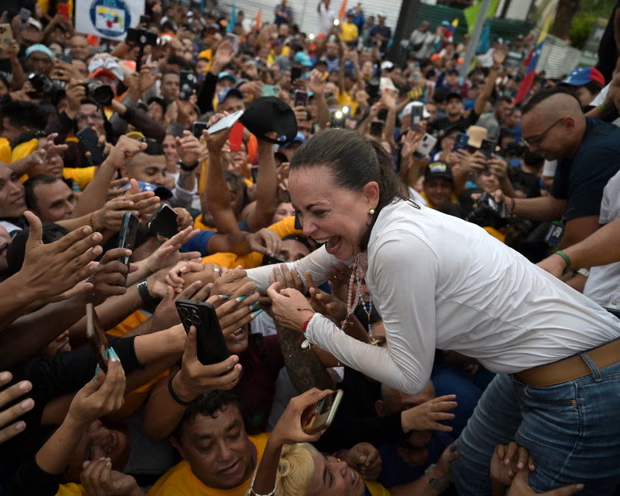
María Corina Machado has won the Nobel Peace Prize for her ongoing struggle against Venezuela’s authoritarian regime under President Nicolás Maduro, putting the spotlight on a country facing political and economic collapse. The award comes more than six years after Venezuela endured a nationwide blackout that left citizens huddled in darkness in the city of Maracaibo, listening to Machado promise hope amid crisis.
At the announcement in Oslo, Machado used words reminiscent of that night. “We are living through the darkest hours. But at the same time there is enormous hope,” she said, vowing that “Venezuela will be free.”
While supporters hope the Nobel accolade will strengthen Machado’s position, analysts remain cautious. International voices welcomed the news. European Commission president Ursula von der Leyen wrote that “the thirst for democracy always prevails,” expressing confidence that the prize could reinforce Machado’s credibility as a key opposition leader. Carlos Lizarralde, an author on Venezuela’s crisis, described Machado as a “secular equivalent of a living saint,” noting her public image as a devout Catholic, often seen clutching a rosary and wearing crosses at rallies.
Yet skepticism persists about the real-world impact of such awards in authoritarian states. David Smilde, a Venezuela expert at Tulane University, said the Nobel will draw global attention and possibly inspire renewed resolve, but it is unlikely to produce fundamental change. He cited past laureates whose recognition did not alter entrenched political conflicts. Ronald Krebs, a political scientist studying Nobel Peace Prizes in authoritarian contexts, noted that prizes rarely achieve systemic reform.
Krebs pointed to the example of Liu Xiaobo, the Chinese activist awarded the Nobel in 2010 while imprisoned. Despite international attention, China’s government tightened control, and Liu died in custody seven years later. Similarly, Iranian activist Shirin Ebadi received the Nobel in 2003, which offered her personal protection but did little to improve conditions for other activists, and in some cases led to harsher repression.
According to Krebs, peace prizes can inspire human rights advocates to act with greater courage but can simultaneously motivate repressive regimes to crack down on unprotected activists, creating a risky dynamic for domestic political movements. Machado’s allies hope the Nobel will shield her from retaliation, though experts caution that it does not guarantee democratic progress.
Even Maduro’s former ally, Andrés Izarra, a former minister under Hugo Chávez, expressed doubt that the prize alone would destabilize the regime, despite acknowledging that Maduro faces unprecedented pressure. The Venezuelan president is internationally isolated after last year’s disputed election and the United States has stepped up military and economic pressure, including naval operations off the Caribbean coast and strikes on alleged drug smuggling operations.
Izarra described these actions as a “performative regime change operation,” aimed at pressuring Maduro into concessions rather than provoking a direct military revolt or invasion. He predicted that any resolution would likely occur at the negotiating table, noting that neither Maduro nor the US wants an extended conflict.
Despite these uncertainties, Machado’s reputation as a determined and principled opposition leader is unlikely to waver. Lizarralde said she remains committed to her cause, viewing her struggle as an epic battle between good and evil, with herself representing the forces of good. Her Nobel recognition reinforces her role as a symbolic figure of resistance in Venezuela, drawing international attention to the country’s prolonged political and humanitarian crises.
While the award highlights Venezuela on the world stage, analysts caution that it may not produce immediate change. Machado’s recognition may empower her personally and provide her protection, but the path to democracy in a deeply entrenched authoritarian system remains uncertain. For now, the prize serves as a spotlight on Venezuela’s plight, the resilience of its opposition, and the ongoing challenge of securing political reform under Maduro’s rule.
