

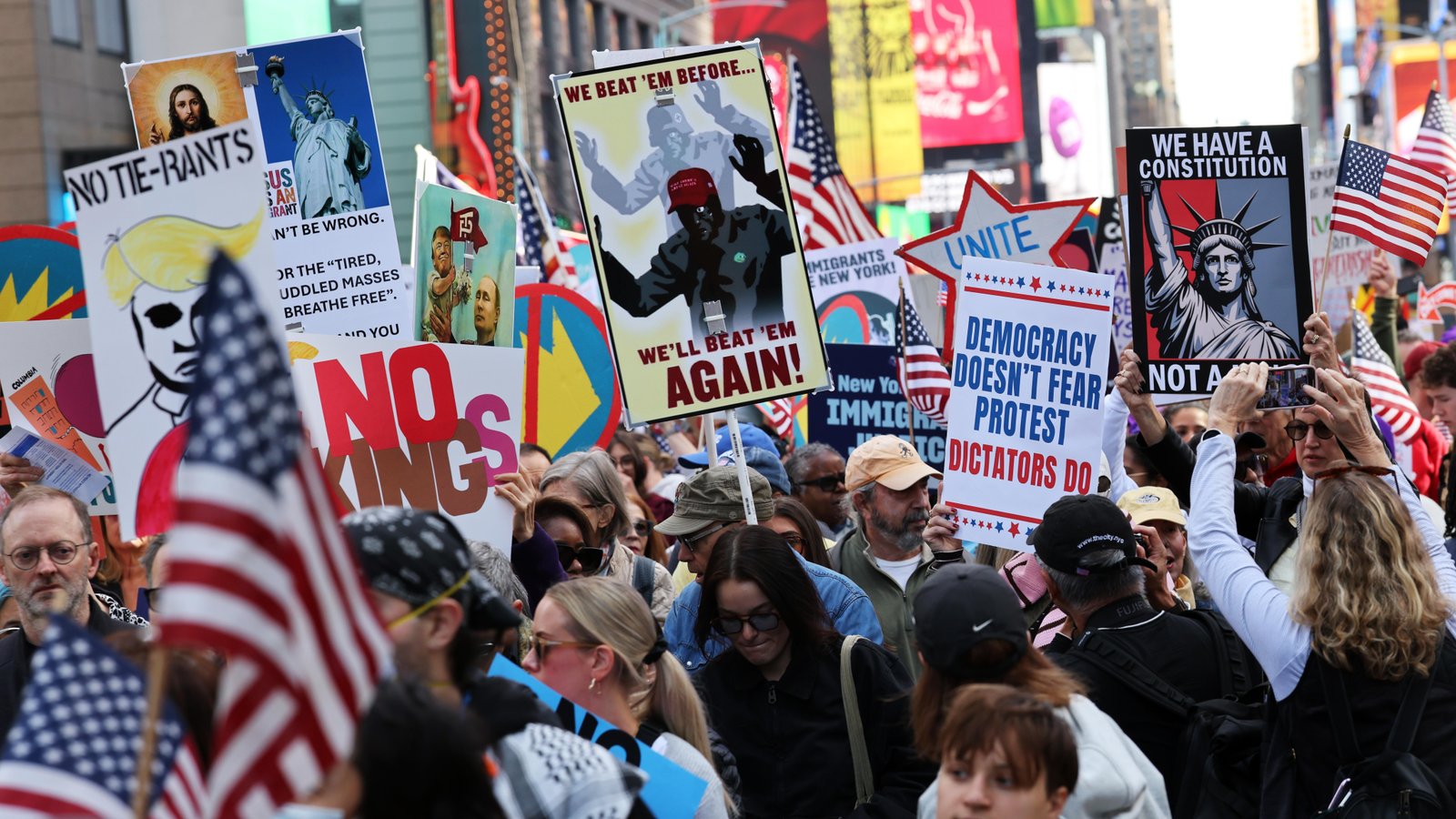
Millions of Americans took to the streets across all 50 states on Saturday for the No Kings protests, a nationwide demonstration against the Trump administration. Participants rallied behind the message that the United States should remain a democracy with no kings and resisted growing authoritarianism.
The protests marked the second major event organized by the coalition this year, following a June march that drew millions in one of the largest days of protest in US history. Communities of all sizes came together with signs, marching bands, large banners featuring the US Constitution’s preamble, and inflatable costumes, including frogs, which have become a symbol of resistance originating in Portland, Oregon.
The events reflected a shift in momentum for Democrats, who had appeared uncertain six months ago about how to counter Republican control of the White House and Congress following significant election losses. “What we are seeing from the Democrats is some spine,” said Ezra Levin, co-founder of Indivisible, a key organizing group. “The worst thing the Democrats could do right now is surrender.”
In Chicago, at least 10,000 people gathered at Grant Park’s Butler Field, many carrying signs against federal immigration agents or mocking Trump. Estimates later placed the crowd at 100,000. Attendees chanted slogans such as “Hands Off Chicago” and “Resist Fascism.” Illinois Representative Jonathan Jackson drew cheers when he spoke, and the crowd erupted in chants against Trump. Chicago Mayor Brandon Johnson warned that the Trump administration sought a “rematch of the civil war” and urged residents to stand firm.
In Los Angeles, 72-year-old Ginny Eschbach attended her 42nd protest since Trump took office, dressing as SpongeBob SquarePants after she could not find an inflatable frog costume. She carried an American flag and said she was concerned about erosion of First Amendment rights. “I personally am not happy with the erosion of our first amendment rights,” she said. “This is my gravest concern, as they attack universities, the media, law firms and now our very own freedom of speech and threaten our ability to peacefully assemble.”
Over 200,000 people gathered near the US Capitol in Washington DC. Protesters in many cities wore inflatable animal costumes, a theme first developed in Portland to counter narratives of lawlessness. While the main march in downtown Portland was peaceful, a smaller protest at an ICE facility faced federal force. Similar events occurred in Santa Fe, New Mexico, where participants wore unicorn, frog, and lobster suits to highlight the absurdity of authoritarian overreach.
In Atlanta, at least 10,000 people filled the Civic Center in preparation for a march to the state capital. Senator Raphael Warnock warned about the presence of federal law enforcement across the country, emphasizing that all Americans should be concerned about these developments.
The protests came amid Trump’s efforts to send federal troops into US cities and expand immigration enforcement. Cities have challenged these actions legally, and residents have taken to the streets to protest militarization in their communities. Trump allies have attempted to label the No Kings protests as anti-American or led by extremist groups. Some state leaders, including Texas Governor Greg Abbott, threatened to send the National Guard to counter the marches.
Democratic Senators Chuck Schumer and Chris Murphy, as well as Independent Senator Bernie Sanders, joined the rallies. The No Kings coalition emphasized nonviolent resistance, and tens of thousands of participants received training on safety and de-escalation tactics. Lisa Gilbert, co-president of Public Citizen, said the protests were a response to fear tactics from the administration. “Millions of Americans will come together in peaceful pro-democracy protests to show that we will never bow to a king,” she said.
Organizers identified anchor cities for the protests, including Washington DC, San Francisco, San Diego, Atlanta, New York, Houston, Honolulu, Boston, Kansas City, Bozeman, Chicago, and New Orleans. The protests highlighted concerns that Trump is using taxpayer funds to expand power, deploying federal forces to take over cities, and acting as if he is already a monarch.
The June No Kings protests had previously drawn between 2 million and 4.8 million people across more than 2,000 locations, making it the second-largest single-day demonstration since Trump took office, second only to the 2017 Women’s March. Saturday’s events built on that momentum, showing widespread public resistance to authoritarian policies and support for democratic freedoms.
