

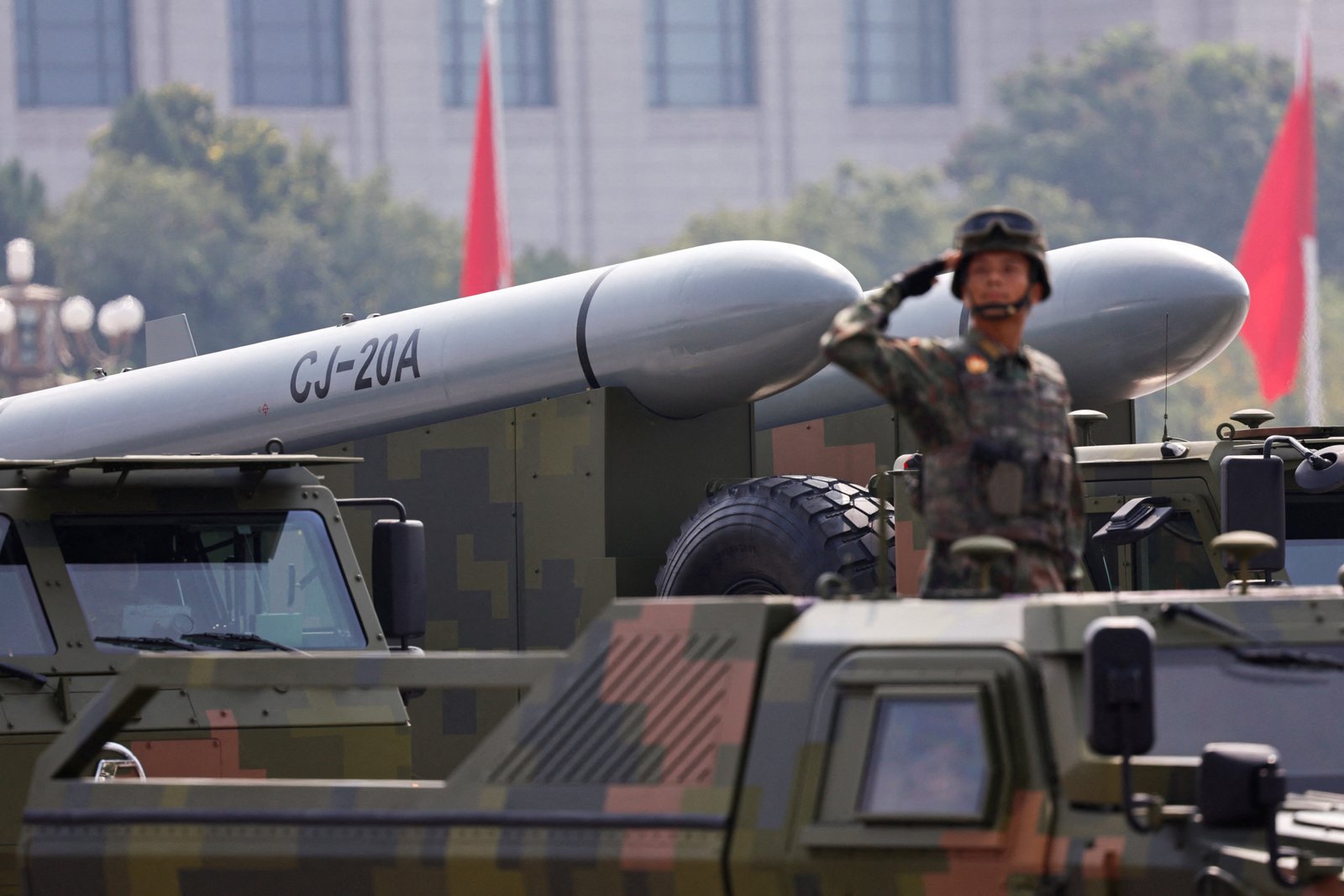
Beijing’s morning sky glowed golden as the capital prepared for a historic military parade. The city’s heart, Tiananmen Square, turned into a stage of military power as China marked the 80th anniversary of the end of World War II.
The event was not just a display of arms but a signal of strength. President Xi Jinping rode in an open car along Chang’an Avenue, inspecting the troops. Citizens lining the streets cheered with excitement, hoping to witness a new chapter of China’s military rise. After greeting the soldiers, Xi took his seat on the Tiananmen rostrum, joined by Russian President Vladimir Putin and North Korean leader Kim Jong Un. The scene sent a symbolic message: China now stands as a global power that cannot be ignored.
As the parade began, about 100,000 troops marched in perfect rhythm. Tanks rolled forward, and ballistic missiles followed in disciplined formation. On television, the sight of weapons and vehicles captivated viewers across the country. Among the highlights was a new addition to the arsenal, a massive submarine drone called the JX. At 20 meters long, it reflected the future of naval warfare.
The air segment added more surprises. Stealth combat drones, known as Loyal Wingmen, flew in formation. These unmanned aircraft are designed to support fighter jets in coordinated attacks, acting as partners in battle. Fighter jets and helicopters later soared across the sky, forming the number 80 as a tribute to the anniversary, while crowds below waved and applauded.
Another striking moment came with the appearance of robotic technology. One model, nicknamed the Robotic Wolf, could detect mines, conduct reconnaissance, and track enemy soldiers. What once seemed like science fiction now appeared in real form.
Missiles took center stage with China unveiling its newest intercontinental ballistic missile, the DF-61. This solid-fueled missile can carry nuclear warheads, marking a major leap in capability. Other missiles included the DF-C, DF-26D, and advanced hypersonic warheads, signaling China’s ability to compete with leading powers like the United States and Russia. Experts noted that the parade demonstrated significant progress in strategic weapons development.
Laser weapons, maritime operation systems, and additional hypersonic missiles such as the YJ-17 and YJ-19 also rolled through the square. The sound of synchronized boots echoed as soldiers maintained strict discipline, reinforcing the parade’s message of unity and strength.
President Xi emphasized in his address that China seeks peaceful development but will never bow to pressure or intimidation. His words, delivered before international guests, carried weight in the current global climate. Analysts said the event was more than a military showcase. It was a political statement about China’s growing influence and determination to assert itself on the world stage.
For ordinary citizens watching in Beijing, the event stirred mixed emotions. Many expressed pride in China’s technological progress, while others quietly wondered about the future. Will these advances remain tools of defense, or could they one day pull the world into new conflicts?
Regardless of the uncertainty, one fact stood clear. The parade demonstrated that China has moved far beyond its older military image. Drones, robotic systems, hypersonic missiles, and disciplined troops painted a picture of a nation advancing rapidly in innovation.
The message resonated both at home and abroad: China is no longer a follower in global defense. Instead, it is a power shaping its future with advanced technology and a firm grip on its role in international security.
