

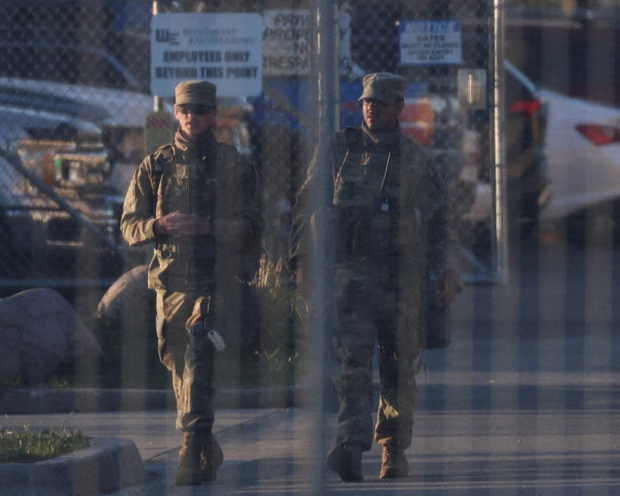
The Trump administration asked the US Supreme Court on Friday to permit the deployment of National Guard troops to Illinois, as the president seeks to expand the use of the military in Democratic-led cities. The Justice Department filed an emergency request asking the court to overturn a lower court decision that blocked the movement of several hundred troops to the Chicago area. The district judge questioned the administration’s reasoning and local conditions.
A federal appeals court upheld the lower court ruling on Thursday, keeping the deployment on hold while the legal challenge continues. Late Friday, US District Judge Sara Ellis ordered federal officers to use body cameras during immigration enforcement, including public interactions. This measure follows a temporary restraining order requiring officers to give warnings before using anti-riot weapons and to wear visible identification. Ellis also requested federal immigration agency representatives appear at a hearing on Monday to report on implementation of her orders, which remain in effect until November 6.
Solicitor General John Sauer, representing the administration, said federal agents have faced repeated threats and assaults in Chicago and the suburb of Broadview, where an Immigration and Customs Enforcement (ICE) facility operates. Trump has already deployed National Guard units to Chicago and Portland, after previous deployments to Los Angeles, Memphis, and Washington, DC. The president has argued that military intervention is necessary to curb unrest and support immigration enforcement.
Trump and his supporters have described these cities as dangerous and overwhelmed by violent protests, framing the National Guard’s role as essential to restoring order. Democratic officials have strongly rejected the claims, calling them exaggerated and politically motivated. They say Trump is misusing his authority to punish political opponents. Judges have also expressed skepticism about the administration’s depiction of events, while local leaders note that most protests over immigration enforcement have been small and peaceful.
A recent report shows that US military veterans have faced arrests and injuries amid protests connected to Trump’s deportation campaign and his expanding National Guard deployments. At the center of the dispute is a federal statute allowing the president to federalize the National Guard only in cases of rebellion or when regular forces are insufficient to enforce US laws. The administration argues that troops are needed to protect federal property and officers from protesters.
Earlier this month, 300 Illinois National Guard members were federalized, and additional Texas troops were ordered into the state. Local leaders condemned the move, and Trump escalated rhetoric, calling for the arrest of Chicago’s mayor and the Illinois governor, both Democrats, accusing them of failing to safeguard immigration officers. Illinois and Chicago jointly sued to block the deployment, and on October 9, district Judge April Perry, appointed by Joe Biden, issued a temporary injunction halting the order.
Meanwhile, in Chicago, at least 11 people were taken into custody outside the Broadview ICE detention center during confrontations between Illinois state police and protesters. The dispute over the National Guard deployment highlights ongoing tensions between the Trump administration and Democratic-led cities, raising questions about the use of federal military forces for domestic operations.
