

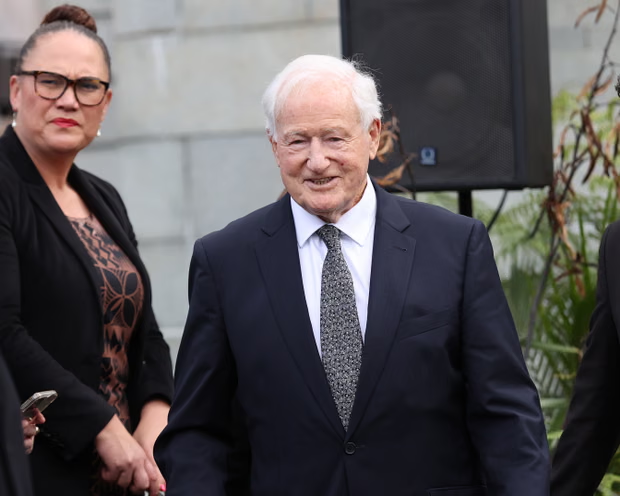
Former New Zealand Prime Minister Jim Bolger has died at the age of 90, leaving behind a legacy marked by reconciliation with Māori and controversial economic reforms. His family confirmed that he passed away peacefully, surrounded by his wife, nine children, and 18 grandchildren. Bolger had been undergoing dialysis following kidney failure last year.
Bolger, a former leader of the National Party, served as prime minister from 1990 to 1997. During his tenure, he implemented sweeping economic changes, including the 1991 “mother of all budgets,” which drastically reduced spending on welfare and health. His government also pursued privatisation and deregulated the labour market, resulting in major declines in union membership.
Despite these policies, Bolger is widely praised for his work on Māori reconciliation. He helped implement the first settlements between Māori tribes and the government to address historical grievances stemming from breaches of the Treaty of Waitangi. Bolger’s efforts in this area are considered a lasting contribution to New Zealand’s social and political landscape.
Bolger began his political career in 1972 and rose to lead the National Party in 1986. After retiring from politics in 1998, he served as New Zealand’s ambassador to the United States until 2002. He also played a key role in establishing the mixed member proportional electoral system that New Zealand still uses today.
Political leaders from across the spectrum paid tribute to Bolger following news of his death. Prime Minister Christopher Luxon described him as “principled and formidable” and praised his ability to separate political disagreement from personal animosity. Labour leader Chris Hipkins highlighted Bolger’s later recognition of inequality and his concern over wealth concentration.
Bolger reflected on his approach to Māori treaty settlements in his book A View From the Top, citing his Irish heritage as a motivating factor in understanding the history of colonisation and advocating for justice. Tukoroirangi Morgan, chair of the Waikato Tainui iwi, said Bolger modernised the process of reconciliation and helped bring New Zealand closer together. Green MP Teanu Tuiono praised Bolger’s commitment to historical justice and the Treaty of Waitangi, noting that he always acted out of a sense of right and responsibility.
Though a committed republican, Bolger did not accept a knighthood after leaving politics. Instead, he was honoured as a member of the Order of New Zealand, the country’s highest civilian distinction.
Bolger’s legacy remains a complex mix of economic reform, political change, and social reconciliation. While some remember him for the austerity measures that reshaped New Zealand’s welfare and labour systems, others celebrate his enduring commitment to Māori rights and national unity.
His death marks the passing of a leader who combined firm political conviction with a dedication to justice and reconciliation, leaving a significant imprint on New Zealand’s history.
