

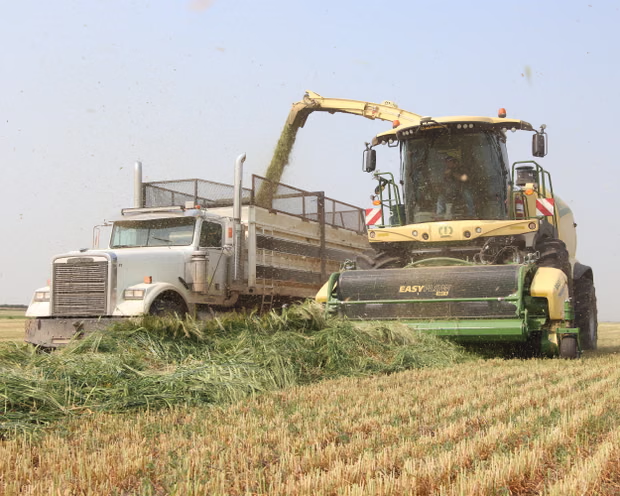
Europe’s leading farm machinery company, Krone, has temporarily halted exports to the United States due to new and little-known tariffs affecting hundreds of products. The levies, described as “alarming,” cover items ranging from hair dryers and knitting needles to combine harvesters.
The tariffs affect 407 steel-derived products, including appliances, agricultural machines, construction equipment, wind turbines, elevators, and bridge structures. Exporters must now provide detailed information on the origin, weight, and value of every steel component, down to nuts and bolts, creating a heavy bureaucratic burden.
Oliver Richtberg, head of foreign trade at the German engineering federation VDMA, called the requirements “practically impossible.” He criticized the EU-US trade deal agreed in July, saying it “is not worth the paper it is written on” and highlighted that the administrative obstacles have forced some companies to stop exporting entirely.
Krone, based in Lower Saxony with 10,000 employees, depends heavily on the US market, generating $130 million in annual revenue. Bernard Krone, the fourth-generation chair of the company, described the tariffs as a “big shock.” While the EU-US deal offered predictability, the publication of the steel derivatives list on 18 August introduced sudden uncertainty.
Krone explained that it was unclear whether the tariffs depend on weight, origin, or the price of raw steel. The list also allows the US to update the rules several times a year, creating ongoing challenges for exporters.
To ship machines to the US, Krone must certify the value and origin of all steel elements in its products. Some machines contain up to 18,000 parts, making compliance extremely difficult. Incorrect documentation could lead to penalties, including 200% tariffs on Russian imports applied to any steel derivative with incomplete paperwork, according to logistics company Flexport.
In response, Krone extended employee holidays in August, paused exports, and temporarily suspended some production lines. After weeks of consulting lawyers and US officials, the company still lacks full certainty on the documentation required.
Instead of risking shipment of large and costly machines, Krone plans to send a “test container” of smaller equipment, including mowers, rakes, and tedders, which help in hay production. Bernard Krone said, “This week, maybe next week, we will ship them over, and four weeks later we will know if the paperwork is correct. It is nerve-racking.”
US customers were surprised by the tariffs, initially believing foreign companies bore the costs. Krone noted that American consumers ultimately pay higher prices. “If farmers’ prices go up, the US citizens shopping at Walmart or Target pay more for daily goods,” he explained.
The paperwork requires proving that every nut, bolt, and nail did not originate in China, adding a significant administrative challenge. EU trade commissioner Maroš Šefčovič described the situation as “very challenging” and has contacted US officials to address the issues.
Bernie Hart, vice-president at Flexport, said the requirements are among the most complex his company has faced. They demand precise data on the country of melt and pour for steel, the country of primary smelt and cast for aluminum, and details down to individual stock units, including size and color.
These new tariffs and detailed documentation rules have already forced European exporters to rethink their US strategies. Krone’s cautious approach highlights the broader disruption caused by the measures and shows the complexity of navigating changing US trade rules.
