

An appeals court has ruled that the National Guard troops sent to Illinois by former President Donald Trump can remain in the state under federal control but cannot be deployed, a decision that pauses the case until further arguments are heard.
The restriction on deploying the troops comes after federal judge April Perry temporarily blocked the National Guard deployment for at least two weeks. Perry found no substantial evidence of a “danger of rebellion” in Illinois as the federal government continues its immigration enforcement efforts in major cities.
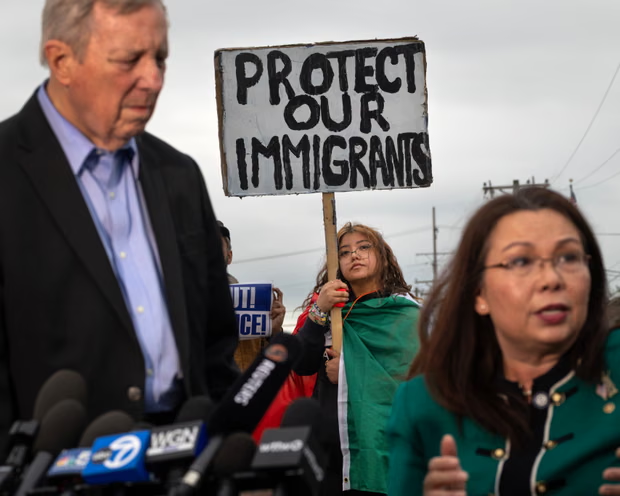
On Friday, Democratic US senators Dick Durbin and Tammy Duckworth visited a suburban Broadview immigration facility near Chicago but were denied entry. The senators had requested a tour of the Immigrations and Customs Enforcement (ICE) building and planned to deliver supplies to protesters who have been demonstrating outside the site for weeks.
Their visit coincided with a federal judge’s order requiring the removal of an eight-foot fence outside the Broadview facility, which the Village of Broadview argued illegally blocked a public street. Both senators criticized the lack of transparency and called for oversight into conditions inside the facility. “We just want to go in and look at the facility and see what the conditions are, and they would not let us in. It is shameful,” Duckworth said. Durbin added, “They’ve refused to tell us this information. I’ve done this job for years, and I’ve never seen stonewalling like this by any presidential administration.”
Meanwhile, in Tennessee, at least nine National Guard members began patrolling the Bass Pro Shops Pyramid in Memphis, about a mile from Beale Street and FedExForum, where the NBA’s Grizzlies play. The troops, wearing fatigues and protective vests labeled “military police,” were escorted by local police and posed for photos with visitors. Similar units were stationed at a nearby tourist welcome center along the Mississippi River.
Trump has proposed or deployed troops to other cities, including Baltimore, the District of Columbia, New Orleans, and several California cities such as Oakland, San Francisco, and Los Angeles. The federal government states that the troops are intended to support immigration agents and protect federal property.
In Memphis, the troops remain under the command of Republican Governor Bill Lee, who supports their use in federal crime enforcement. In contrast, Trump attempted to deploy troops from other states, including Texas and California, to cities like Portland and Chicago without state consent. Courts in Illinois and Oregon blocked these actions, citing violations of state sovereignty and federal law.
Judge April Perry in Chicago ruled that the Trump administration had violated the 10th Amendment, which protects state powers, and the 14th Amendment, which guarantees due process and equal protection. In her written order, Perry emphasized the historical reluctance in the United States to involve the military in domestic policing, noting that even Alexander Hamilton did not support sending one state’s militia to another for political purposes.
Illinois Governor JB Pritzker supported the court’s ruling, stating, “There is no credible evidence of a rebellion in the state of Illinois. There is no place for the National Guard in the streets of American cities like Chicago.” A similar court battle in Oregon delayed troop deployment to Portland, where the 9th US Circuit Court of Appeals heard arguments on Thursday. Lt. Cmdr. Teresa Meadows, a spokesperson for US Northern Command, confirmed that the troops sent to Portland and Chicago are “not conducting any operational activities at this time.”
