

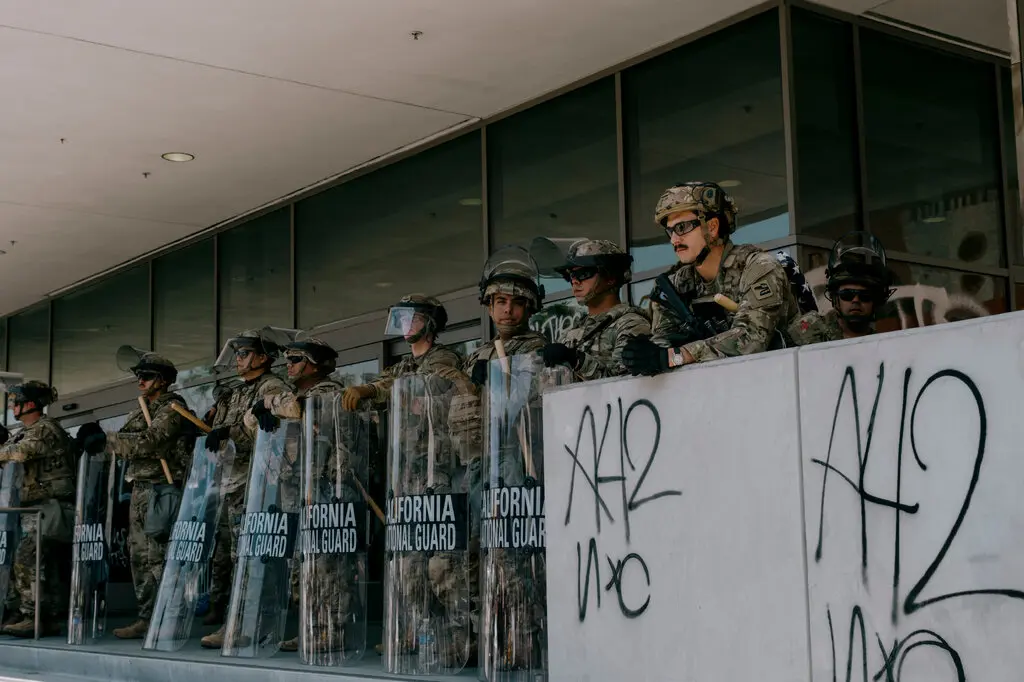
California Governor Gavin Newsom announced that he is suing President Donald Trump over the deployment of 300 California National Guard members to Oregon, calling the move an attack on the rule of law. Newsom said the administration is defying court orders and politicizing the judiciary.
“They are on their way there now,” Newsom said in a press statement. “The Trump Administration is ignoring court orders and treating judges as political opponents, even those appointed by the President himself.”
The Pentagon confirmed the deployment on Sunday. Pentagon spokesperson Sean Parnell stated that, “At the direction of the President, approximately 200 federalized members of the California National Guard are being reassigned from duty in the greater Los Angeles area to Portland, Oregon to support US Immigration and Customs Enforcement and other federal personnel performing official duties, including enforcement of federal law, and to protect federal property.”
Newsom’s lawsuit follows a federal judge’s decision blocking the Oregon National Guard from being deployed to Portland. US District Judge Karin Immergut ruled that sending troops could inflame tensions rather than reduce them. The order delays any deployment until at least October 18.
Portland officials noted that recent protests against federal immigration enforcement had been largely peaceful. Caroline Turco, the city’s senior deputy attorney, said there has been no violence against ICE officers for months, with some demonstrations involving fewer than a dozen participants.
“This isn’t about public safety, it’s about power,” Newsom said. “We will take this fight to court, but the public cannot stay silent in the face of reckless and authoritarian conduct by the President of the United States.”
Oregon Attorney General Dan Rayfield said the state is “quickly assessing our options and preparing to take legal action.” He added, “The President is obviously determined to deploy the military in American cities, absent facts or authority to do so. It is up to us and the courts to hold him accountable. That’s what we intend to do.”
The California National Guard referred questions to the Department of Defense, which declined to comment. The White House defended the deployment, with Deputy Press Secretary Abigail Jackson stating, “President Trump exercised his lawful authority to protect federal assets and personnel in Portland following violent riots and attacks on law enforcement. For once, Gavin Newsom should stand on the side of law-abiding citizens instead of violent criminals destroying Portland and cities across the country.”
The Oregon deployment follows a series of federal interventions in other states, including National Guard deployments to Chicago. Trump first announced the Portland deployment on September 27, saying he was “authorizing full force, if necessary,” despite objections from Oregon officials and members of Congress.
Trump has repeatedly described Portland as a “war-ravaged” city, citing small protests against ICE as justification for sending troops. During his first term in 2020, he deployed federal forces to Portland amid nationwide demonstrations following the murder of George Floyd.
Newsom criticized the latest deployment, calling it “appalling, un-American, and must be stopped,” and reaffirmed his commitment to challenge the administration’s actions in court. The dispute highlights ongoing tensions between state and federal authorities over the use of military forces in domestic cities. It also raises questions about executive authority, civil liberties, and the limits of federal intervention in state matters.
The California National Guard lawsuit underscores the broader debate over the balance of power between state governments and the federal administration. Analysts say the legal battle will test the limits of presidential authority and could set a precedent for future deployments of military forces in domestic settings.
As protests remain peaceful in Portland, the lawsuit places emphasis on the legality and necessity of the federal response. Both state and federal officials are preparing for what could become a protracted legal conflict, highlighting the political friction between California and the Trump administration.
The case also signals a broader push by states to assert their authority when they believe federal actions may exceed legal bounds. How the courts rule could have implications not just for California and Oregon, but for the use of National Guard and federal troops across the United States in the future.
