

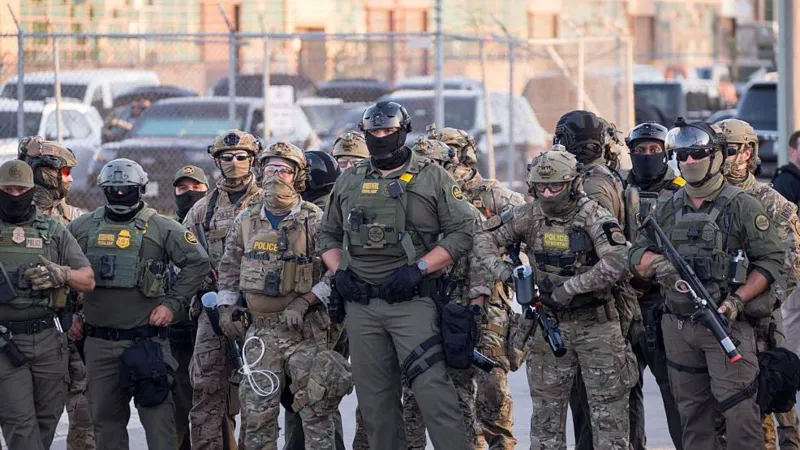
President Donald Trump has authorized the deployment of 300 National Guard troops in Chicago to protect federal officers and facilities, the White House confirmed. The move follows a border patrol incident in which agents shot a woman after a vehicle attack. White House spokesperson Abigail Jackson said Trump acted due to “ongoing violent riots and lawlessness” that local leaders failed to control. She added that the president “will not turn a blind eye to lawlessness plaguing American cities.”
Illinois Governor JB Pritzker criticized the deployment as unnecessary, calling it a “manufactured performance – not a serious effort to protect public safety.” He said the Pentagon had demanded the governor call up troops or face federal intervention. “It is absolutely outrageous and un-American to demand a governor send military troops within our own borders and against our will,” Pritzker said. He warned that the order would take working Americans away from their jobs and families for political theatrics rather than real safety concerns.
The deployment comes amid a strong immigration crackdown by U.S. Immigration and Customs Enforcement (ICE) in Chicago. The operation has drawn opposition from local civic groups and Democratic officials. Local, state, and county law enforcement are coordinating security for ICE’s Broadview facility on the city’s outskirts. On Friday, 13 people were arrested during protests against the federal enforcement surge.
The Department of Homeland Security confirmed that a woman was shot on Chicago’s southwest side after border patrol agents were rammed by vehicles and boxed in by multiple cars. Officials said a suspect tried to run over agents, prompting them to fire in self-defense. DHS spokesperson Tricia McLaughlin said the woman, a U.S. citizen armed with a semi-automatic weapon, had been identified in a Customs and Border Protection intelligence bulletin last week for doxing agents. She was treated at Mount Sinai Hospital and released. No officers were seriously injured.
The shooting follows a similar federal incident last month when ICE agents killed a Mexican immigrant in a Chicago suburb after he allegedly struck an officer with his car while fleeing a traffic stop.
Chicago is among several U.S. cities where Trump has deployed or threatened National Guard troops to support police in immigration enforcement or respond to disputed claims of rising crime. Homeland Security Secretary Kristi Noem and border patrol sector chief Gregory Bovino visited the Broadview facility on Friday. Noem announced reinforcements on social media, saying, “I am deploying more special operations to control the scene. Reinforcements are on their way. If you see a law enforcement officer today, thank them.”
The Trump administration maintains that crime in Chicago has surged in recent years, though independent reports suggest these claims may be exaggerated. ICE operations have included helicopter surveillance, apartment raids, and arrests of local officials and political candidates protesting the enforcement measures. Critics argue these actions politicize federal law enforcement and military power.
Trump has repeatedly deployed National Guard troops nationwide, including in Los Angeles and Washington, D.C., despite federal limits on military involvement in domestic policing. These deployments have raised widespread concern about the role of the military in civilian law enforcement.
Meanwhile, a federal judge blocked Trump from sending the National Guard to Portland, Oregon. U.S. District Judge Karin Immergut, a Trump appointee, ruled that federal deployment could worsen tensions rather than reduce protests. The restraining order cited past cases where federal troop presence inflamed unrest, highlighting legal limits on domestic military intervention.
The Chicago deployment highlights ongoing tensions between federal authority and state control, as well as political stakes surrounding immigration enforcement and public safety. Governor Pritzker and local officials continue to oppose the move, arguing it prioritizes political messaging over protecting residents and communities.
