

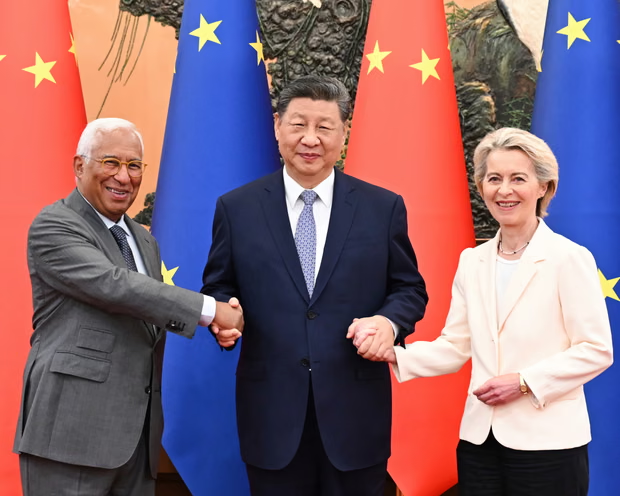
Europe’s relationship with the United States is increasingly unmoored, and the continent has also lost clarity on China. Caught between competing forces, Brussels now faces strategic dilemmas with no easy answers.
Historically, Europe’s China policy was shaped largely by Washington. During Barack Obama’s attempted pivot to Asia in 2011, Europe assumed it could pursue economic engagement with China while leaving security concerns aside. For years, initiatives like the Belt and Road were seen primarily through an economic lens, with limited strategic consideration.
Tensions in the South China Sea, the Korean Peninsula, and the Taiwan Strait gradually shifted European thinking. Under the Trump and Biden administrations, Europe began viewing China not just as a partner but also as a systemic rival. The EU implemented investment screenings, tariffs, and export controls while advocating for “de-risking” economic dependency. The message was clear: Europe’s approach to China was closely tied to the US.
This alignment worked while transatlantic relations were strong and predictable. Today, Washington’s position is less reliable. For example, Trump might pressure Europe to impose economic costs on China, yet simultaneously avoid standing by Europe on Ukraine. Beijing has largely retained leverage in the US-China trade dynamic, while Europe struggles to find its independent footing.
Europe now faces difficult policy choices: should it adopt trade protectionism to counter Chinese overcapacity, encourage technology transfers to maintain global trade stability, or embrace Chinese green tech to meet climate goals without creating dependency? Can Europe realistically challenge China’s Belt and Road initiative in the Global South, or should it accept a complementary “Global Gateway” strategy?
Underlying these strategic questions are two critical dilemmas for Europe. First, liberal democracy is under threat within the continent. Far-right, nationalist, and populist movements, along with polarisation and disinformation, challenge fundamental freedoms and the rule of law. China, as an economically successful authoritarian state, provides a subtle inspiration to illiberal forces. Hungary, Slovakia, and Serbia, for example, maintain close ties with Beijing, highlighting the magnetic pull on Europe’s illiberal factions.
Second, Europe’s security dilemma, particularly regarding Ukraine, remains unresolved. China claims neutrality but increasingly sides with Moscow, providing economic and technological support. Europe cannot expect China to curb its relationship with Russia, leaving Brussels reliant on the US for defense commitments—even as Trump’s inconsistent approach casts doubt on Washington’s reliability.
Europe now finds itself in a delicate balancing act. Russia represents a direct threat to European security, necessitating a strong transatlantic alliance. Yet confronting China simultaneously is far more complex. Beijing views Europe through the lens of US competition and prioritizes keeping Russia aligned with its strategic objectives. In China’s calculation, Russia trumps Europe.
The result is a strategic squeeze: Europe must manage relations with two superpowers while defending its economic interests, security, and liberal democratic values. Wishing the problem away is no solution; the continent must confront its dual challenge with careful planning, strong alliances, and a clear vision of its own geopolitical role.
