

European markets have faced turbulence recently, with the pan-European STOXX Europe 600 Index dropping nearly 2%. Concerns over the U.S. Federal Reserve’s independence and renewed tariff uncertainties have added pressure to investors. In this environment, European dividend stocks can provide stability and income potential for those seeking steady returns.
Investors looking for income in uncertain markets often turn to dividend-paying stocks. These stocks provide regular payouts, which can act as a buffer when market prices fluctuate. In Europe, a number of companies offer attractive dividend yields supported by strong earnings and cash flows. Some of the top dividend stocks in Europe include Zurich Insurance Group, Telekom Austria, Rubis, Holcim, HEXPOL, DKSH Holding, Cembra Money Bank, CaixaBank, Banque Cantonale Vaudoise, and Afry. Their dividend yields range from 4% to over 7%, offering investors reliable income streams.
Transilvania Investments Alliance is a closed-ended financial investment company with a market capitalization of RON 941 million. Its revenue comes from financial services, specifically closed-end funds, totaling RON 112.59 million. The company offers a dividend yield of 3.37%. Although this is below Romania’s top quartile, the stock trades at a price-to-earnings ratio of 11.4x, compared with the market average of 15.8x. Dividends are well-supported by earnings and cash flows, with payout ratios of 38.5% and 54.8%, respectively. Recent growth in earnings could help maintain future dividend stability.
Gimv NV is a private equity and venture capital firm based in Belgium, with a market cap of €1.66 billion. It invests directly and through fund-of-funds strategies across sectors including Consumer, Smart Industries, Sustainable Cities, Infrastructure Works, and Health & Care Excluding Life Sciences. Gimv offers a dividend yield of 5.77%, below Belgium’s top quartile but stable over the last decade. Despite limited free cash flow coverage, a payout ratio of 34.8% ensures dividends are supported by earnings. The stock trades 43.4% below its estimated fair value, offering potential for capital appreciation.
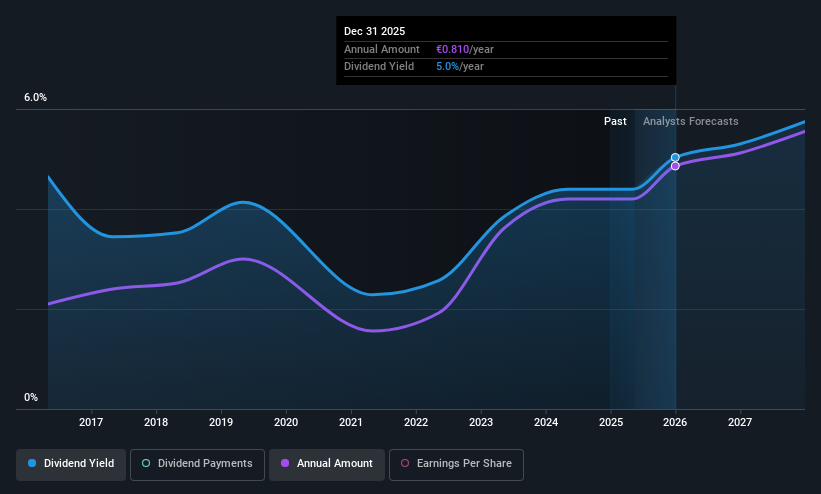
Logwin AG provides logistics and transport solutions in Germany, Austria, other parts of Europe, Asia-Pacific, and globally. The company’s market cap stands at €771.63 million, with revenue coming primarily from its Air + Ocean segment (€1.24 billion) and its Solutions segment (€252.53 million). Logwin’s dividend yield is 4.8%, placing it in the top 25% of German dividend payers. Payout ratios of 59.6% for earnings and 36.6% for cash flow indicate a sustainable dividend. Despite a slight drop in net income during the past half-year, the company showed increased sales to €692.27 million. Logwin trades below its fair value, suggesting potential growth.
Dividend stocks can provide financial security when markets are volatile. They offer regular income, which can help investors offset price swings. European dividend stocks are particularly attractive because many have a long history of stable payouts. Companies with solid earnings, low payout ratios, and a record of dividend consistency tend to weather market challenges better than non-dividend-paying peers. Investors can explore more than 225 European dividend stocks for potential investment opportunities. Some smaller-cap companies also offer strong growth prospects and cash flow potential but have yet to gain widespread analyst attention. Such stocks may be trading below their fair value, presenting opportunities for long-term gains.
Investors can enhance their decision-making by using market intelligence tools. Portfolio tracking, notifications, and detailed stock reports can help evaluate dividend sustainability and growth potential. Understanding historical trends, payout ratios, and valuation metrics allows investors to make more informed decisions. European dividend stocks remain a viable strategy for generating income and balancing risk in turbulent markets. By focusing on well-rated, sustainable dividend payers, investors can navigate uncertainties while positioning themselves for potential capital appreciation.
